
Tag Archives: volkswagen

Video: 2012 Volkswagen Passat TDI commercial shows you can learn a whole language before refueling

Volkswagen commercials have always known to be pretty witty. That’s definitely the case in the new commercial for the 2012 Volkswagen Passat TDI called – ‘Vamonos.’

The commercial shows two friends taking a road-trip and instead of listening to music – the driver pops in a ‘Teach Yourself Spanish’ CD. The two end up driving for 13 hours without refueling… and without music.

Refresher: The 2012 Volkswagen Passat is offered in three trim levels, S SE and SEL. Entry-level 2012 Passat models are powered by a 2.5L 5-cylinder engine making 170-hp and 177 lb-ft of torque. Standard transmission choice include a 5-speed manual while an optional 6-speed automatic is available. Moving up, buyers can pick a 2.0 TDI Clean Diesel 4-cylinder unit making 140-hp and 236 lb-ft of torque. Mated to a 6-speed DSG transmission, the 2012 Passat TDI gets 43 mpg on the highway and a range of approximately 800 miles. The range-topping 2012 Volkswagen Passat is powered by a 3.6L VR6 units producing 280-hp and 258 lb-ft of torque. Mated to a 6-speed DSG, the 2012 Passat VR6 will get 28 mpg on the highway. Prices will start around $19,995.

Article Source

Car ads make a big comeback at this year’s Super Bowl

superbowl car ads

On February 6, 2011, more than 15 car commercials are scheduled to be shown during the SuperBowl XLV to be held in the Dallas Cowboys Stadium, USA.  So if you’re one of those fans who watch this much-celebrated sports event not just for the game, but for the commercials—you’re in for a treat because the biggest carmakers are set to battle in their own field, as they dominate the advertisements’ airtime spots.
This of course, is making a lot of buzz, especially because car ads have sort of been in absence when these companies were hit with their respective crises.  And to get even more out of this buzz, the commercials are currently enjoying countless thousands of views on YouTube even before the big game.

As of late, there are eight brands confirmed as advertisers.  This list is lead by German brands Volkswagen, Mercedes Benz, BMW and Audi.  Also included are US giants General Motors and Chrysler, and Korean brands Hyundai and KIA.   Some of these carmakers are even buying more than the usual 30-seconder slot, which even heightens the excitement factor.

It should not be a surprise to see that more than 50% of the ads are from German brands.  These European players have been on a roll in the US market for a while now, and they are breaking their sales records.  Earlier reports have claimed that Audi is on its way to exceeding over 100,000 cars sold—its first time in the US.  Mercedes-Benz, for its part, will be joining the pack and showing its first Super Bowl ad throughout its more than 100-year history.  Volkswagen, like what it has done in the past, is targeting younger audiences with a rather cute campaign.  This year, these German players want to keep their good sales momentum, so airing their advertisements during the Super Bowl makes complete sense.

It will be remembered that last year, both Audi and Volkswagen had memorable Super Bowl ads which doubled as social media campaigns.  They were known to use a bit of humor which made them stand out from the usual action-laden, technology-savvy themed advertisements, so fans are excitedly awaiting this year’s offering.

It is also expected that Korean brands KIA and Hyundai will present cool commercials, as they have already done in the past.  And after a not so great ad last year, Chrysler may have something to prove this year.  Same goes for GM, which relatively speaking, has come a long way from where they were during crisis times.

While it is definitely good news to see these carmakers make a Super Bowl comeback, it would certainly be interesting to watch what they will do to stand-out from all the rest.  With as many brands advertising in the same program block, time will tell if the price of those ad slots will be worth it.  After all, in the end, it’s the sales figures that count.

If you would like to purchase high quality parts at discounted prices for any of the car brands mentioned in this article, check out Autopartsway.com.

Volkswagen’s 313MPG XL1 Concept Plug-in Diesel Hybrid

XL1 Concept

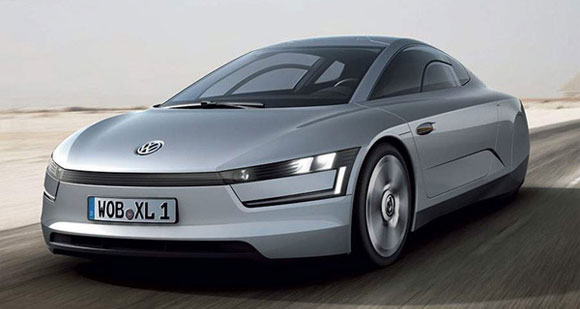
Volkswagen has just announced the 313MPG XL1 Concept Plug-in Diesel Hybrid. Although we are sure there is some questionable math what gives the XL1 the 313MPG fuel efficiency, driving could become much more efficient. While producing only 24g of CO2 per kilometer traveled, Volkswagen focused on making this concept car as light and aerodynamic as possible. With only a 795kg curb weight, the XL1 is constructed using carbon fiber, magnesium, ceramics, and aluminum.

Check below for the full press release.

Volkswagen unveils the XL1 Super Efficient Vehicle in Qatar

The new Volkswagen XL1 Super Efficient Vehicle (SEV) has been unveiled at the Qatar Motor Show. Pioneering construction techniques, an advanced plug-in hybrid drivetrain and innovative packaging all play a part in allowing the XL1 to return 313 mpg on the combined cycle while emitting 24 g/km of CO2 to set a new benchmark for vehicle efficiency.

Powering the XL1 is a compact 800 cc TDI two-cylinder common rail diesel engine developing 48 PS. It’s linked to an electric motor producing 27 PS, resulting in a total of 75 PS – a modest output yet more than enough when the low kerb weight (795 kg) of the vehicle is taken into account.

The TDI engine is linked to an electric motor and a seven-speed DSG gearbox with an automatic clutch mounted between each unit. The electric motor can either work independently of the TDI engine or in tandem when accelerating. In pure electric mode the XL1 can travel up to 35 km before the diesel engine cuts in. Accelerating from rest to 62 mph can be achieved in 11.9 seconds; the electronically limited top speed is 99 mph.
XL1 Concept Side-Back

In both its styling and packaging the XL1 draws on lessons learned from the 1-Litre car (2002) and the L1 concept (2009). The XL1 has evolved to feature staggered seating with the driver and passenger placed next to each other in a body structure made from advanced new materials providing immense strength yet weighing just 230 kg.

To make such weight savings possible, and yet viable for series production, Volkswagen developed and patented a new system for the manufacture of the Carbon Fibre Reinforced Polymer (CFRP) parts on the car called the Resin Transfer Moulding (RTM) process.

In total the XL1 weighs 795 kg. In addition to the body structure, the weight is accounted for by the drivetrain (227 kg), the running gear (153 kg), the interior including a pair of bucket seats (80 kg) and the electrical system (105 kg). In total just 23.2 per cent of the car (184 kg) is made out of either steel or iron.

Further savings are made through the extensive use of lightweight materials including magnesium (wheels), ceramics (brake discs) and aluminium (dampers, steering system, brake calipers).

The styling of the XL1 is borne out of functional requirements – easy access to the interior is granted via a pair of elegant scissor doors that hinge on the A-pillar while the profile of the car has been honed in the wind tunnel, the result being a remarkable coefficient of drag figure of 0.186. The XL1′s overall length (3,970 mm) and width (1,682 mm) are similar to those of a Volkswagen Polo yet its height (1,184 mm) is more akin to that of a Lamborghini Gallardo Spyder.

Although the XL1 is still very much a concept, its unveiling marks the next step towards the birth of a new class of Super Efficient Vehicles, while the advent of a process such as RTM is a significant milestone.

Switch to our mobile site