
Monthly Archives: April 2011

Does your car need new shock absorbers?

shock absorber

Perhaps the simplest way to answer this question is that, the time for replacement comes when your shock absorbers are worn out, damaged or leaking. But how exactly do you spot these signs? Here are some tips to know if you need new shocks, or struts, as many people call it.

It is quite easy to spot if there is any leaking. You simply need to check for traces of oil or any wetness on the outer part of the shock or strut. A simple visual inspection can also reveal damage in terms of broken mounts, badly dented housing, etc. Often, the more difficult thing to spot is the wear on the shocks. It can be very subjective, as there may be instances when the original equipment shocks are not worn, damaged or leaking, but they are also not performing at par to normal expectations. In these cases, you can choose to upgrade your suspension to have a stronger, stiffer and more special shock. This can significantly improve handling as well as trailer towing, hauling overloads in your vehicle and other special uses.

To make things trickier, shocks or struts are not like filters or spark plugs that have standard replacements guides when they reach specific mileage intervals. Still, shock absorbers do get worn out and thus need replacement eventually. The trick is, there are not really any standard guidelines as to when they should be replaced. Some original equipment shocks can last after 30,000 to 40,000 miles. Some struts can last even after 50,000 to 60,000 miles. The exact replacement time is difficult to say because the damping qualities of shocks and struts experience gradual deterioration over time, and due to this gradual change, it is usually difficult to notice the decline in ride control. In most cases, when people notice that the shocks must be replaced, it has exceeded the optimal point in time for replacement.

One tip that you can use to check whether you need new struts is to reflect about how you have been using your vehicle. You can ask yourself several questions. Are you mostly driving on smooth traffic or rough roads? Do you pass through rough roads and bumps where your vehicle cannot stop to bounce excessively? Does your nose dip when you hit the brakes? Does the car body roll or sway too much when you are cornering or driving in crosswinds? Does the suspension bottom out when backing out the driveway or when you are hauling too many passengers or excess weight? If you answer yes to most or all of these questions, you should think of having more serious checks to see exactly what is wrong, or to what extent. A simple “bounce test” is still a good and valid way to check the dampening ability of your shocks and struts. If you find that the suspension continues to gyrate more than a couple of times after rocking and releasing the bumper or the body, it means that your shocks and struts are reaching their prime age and are in need of replacement.

Reasons for Replacements

Even if worn out shocks and struts are not direct causes of possible driving hazards, or even if you can bear the constant bouncing inside your vehicle, there are some studies that show that worn out shocks can increase the distance that it takes to put the vehicle to a full stop, especially on rough surfaces. Weak shocks or struts can result in increased body swaying as well as skidding on wet or slippery surfaces. Worn out shocks can also marginally increasing suspension wear, which in turn can affect tire wear.

Still, the most common reason for shock absorber replacement is to improve the overall ride quality. I don’t know about you, but I have endured 2 hours of bumpy ride o a van with defective shock absorbers, and it is not a pleasant experience at all. Replacing your worn out shocks can firm up your suspension and restore proper ride control.

Then again, if you are interested in even better performance, you can upgrade to gas-charged shocks or struts. These types are charged with high pressure nitrogen gas that can help minimize the foaming in the hydraulic fluid inside the shock. This can also lessen the “fade” on rough surfaces and can help the vehicle keep a better ride control even when cornering.

You can also resort to some “heavy-duty” replacement shocks and struts, as they have larger diameter pistons than stock. These types can also provide increased resistance, which gives the driver greater control. However, it may be a little too harsh for everyday driving. For this reason, some shocks have special valving or adjustable valving that allows some flexibility in the amount of resistance.

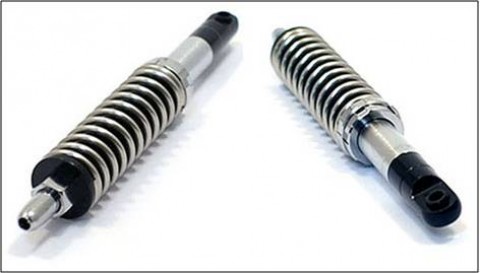
Still another option to consider if you are hauling extra cargo is to use overload or air-assist shocks. Overload shocks have a coil spring around them that increases the load carrying capacity of the suspension. These shocks also have the tendency to ride stiffer than standard replacement shocks. Moreover, these air-assist shocks have an adjustable air bladder that functions like a spring to allow you to carry more weight. With this type of shock, air can be added on a per-need basis when hauling extra weight.

About the replacement

You should note that shocks and struts are usually replaced in pairs. However, some there can be some exceptions especially if only one shock or strut is leaking or has suffered damage and you vehicle still has a very low mileage, and the other shock is still in tip-top shape.

The good thing is that shocks are a good do-it-yourself item almost all vehicles, because they are relatively easy to replace. On the other hand, some struts need a fair amount of suspension disassembly knowledge and skill. Part of it is also some wheel realignment. Thus, while you can replace your own shocks, it is advisable to have a professional mechanic replace your struts for you.

If you would like to purchase high quality car components online at discounted prices, please check out autopartsway.com.

Carmakers shutdown plants after Japan earthquake

JAPAN TSUNAMI

Several car manufacturers have suspended production in their Japanese plants following the 8.9 magnitude earthquake and tsunami that hit Japan recently.  The list includes Toyota Motor Corp, Honda Motor Corp, Nissan Motor Corp and Subaru.  Meanwhile, employees of foreign car companies in Japan like BMW are also being temporarily sent back to their home countries. 

According to the Japan Meteorological Agency, the massive earthquake struck Japan at 2:46 p.m. local time off the coast of Sendai, and north of the capital.  The tremor also triggered a tsunami that flooded coastal areas. Several TV footages showed cars, trucks and even large cargo ships being washed down the flood zones and brought inland.

It has been previously reported that at least one person died at Honda’s R&D facility, and there have been fires that erupted at two Nissan plants.  There have also been limited and weak phone coverage in the quake zone, which makes it harder for the companies to have a clearer picture of the extent of the damage.  As of yet, Japanese authorities in Northern Japan are in the process of sifting through the wreckage and tallying the death tolls and property damage.

This natural disaster resulting in these massive shutdowns could have an effect to the United States, because many car models intended for the U.S. market are produced in Japan like the Toyota Yaris sedan, Scion XB and Scion XB, and the Honda Fit subcompact vehicle.

Big Hit on Toyota

Toyota, which is currently the world’s largest automaker, announced that it has evacuated workers from several factories within the quake zone.  Toyota has two production plants assembling auto parts in Northern Japan.  Moreover, its parts affiliates, Kanto Auto Works, Ltd. and Central Motors Co., also have assembly plants in that region.  According to Toyota’s spokesperson Dion Corbett,  the status of the plants are currently being evaluated, and they are still “trying to get information from them.”

Toyota has unsurprisingly a large manufacturing presence in Japan, particularly in the northern regions.  The company has had plans to make northern Japan a center for small car production.  Last January, its affiliate, Central Motors, opened an assembly plant an hour away from Sendai, which is one of the most affected areas.  That plant, which has a capacity of producing around 120,000 vehicles, produces the Yaris, Toyota’s compact car model that is being exported to the U.S.  Another Toyota affiliate, Kanto Auto Works, has another assembly plant in the nearby prefecture of Iwate.  This plant also makes compact cars, including the Yaris, Scion xB and Scion xD. 

Meanwhile, Toyota’s plants near the company’s headquarter in Toyota City, which is in Central Japan, had resumed operations after a few brief shutdowns.  There were also no reported injuries; however, the company is still checking for any possible damage.

Even some of Toyota’s suppliers suffered similar fates.  Tota Boshoku Corp., and Denso Corp., which are two of Toyota’s biggest parts suppliers, were both reported to have suffered some plant damage.

Other Carmakers

In other reports, Honda has shutdown two assembly plants immediately after the earthquake.  Honda’s Sayama plant in the northern part of Tokyo and closer to the epicenter remains closed. Honda’s spokesperson Yamamoto, mentioned that Honda’s Japanese headquarters were having difficulties in contacting their plants, including the Sayama plant, which produces U.S. bound models, which includes the Fit small car, the Accord sedan, the CR-V crossover, as well as the Acura RL and Acura TSX.  The company is still unsure about when the production would resume.

Honda has also announced that it would close its R&D centers in Sayama and Suzuka factories temporarily.  At Honda’s R&D Center in the Tochigi prefecture, one person has died and 30 were injured following the earthquake when a wall was toppled at the center’s cafeteria.  Other than these, no other injuries were reported.  Meanwhile, Honda’s plants in Central Japan, like Toyota soon re-started production.

Nissan Motor Co. also suspended operations in their plants located in Eastern Japan.  There were small fires that broke out at two of the company’s assembly plants, including a factory that produces the Infiniti M sedan and GT-R sports car.  The fires were extinguished immediately.  Still, Nissan has evacuated employees from its technology center just south of Tokyo when the power was cut-off in that area.  Nissan said that some plants would remain closed temporarily, and the company will decide when production can be safely resumed, following an assessment of the damage brought about by the earthquake.

Meanwhile, Subaru  maker Fuji Heavy Industries Ltd. also closed five factories, according to spokesperson Kenta Matsumoto.

Truck maker Volvo AB was among those hit the worst, with its main production in Japan forced into suspension.  The Swedish company, who is among the world’s leading truck makers, said that the damage to its facilities in Ageo in Southeasten Japan was mainly superficial, but it will take several days before the company can have a full assessment of the damage.  Volvo employs 10,000 people in Japan for their production plants and with an additional 3,000 in the dealerships.  Volvo also mentioned that the dealership at Sendai had serious damages, but that the total effect on dealerships are yet to be determined.

AAA Releases New List of Top Auto Technologies

AAA

The American Automobile Association (AAA) has recently named its top picks for new vehicle technology.  This biennial list is developed by a team of automotive experts and aims to feature various interesting vehicle technologies intended to improve safety, increase performance and reduce the environmental impact of the newest automobile models in the market.  

According to the AAA National Director of Auto Repair and Buying Services John Nielsen, “Every model year, automakers find new ways to employ technology in their vehicles to enhance the driving experience.  While many of the innovations continue to focus on safety and performance, we’re also seeing more new technologies that address the environmental impact of the vehicles we drive, which is evident in this year’s list.” 

AAA’s experts claim that not all new vehicle technologies have a positive effect on the vehicle’s function or the driver’s safety.   In support of this claim, Nielsen added that “Many new technologies can distract drivers who end up multi-tasking behind the wheel, which takes their focus off the primary task at hand—safely driving the car.” 

Given these guidelines, here are AAA’s top picks for the latest new vehicle technology:

All-Electric Vehicles – The Nissan Leaf is the first to market from a major car brand in this category.  The Leaf can be a practical option for many commuters with its estimated 100-mile range between charges.  Performance-wise, it is a smooth drive and has a well-designed interior, with the power consumption measured on a cents per mile basis.  Basically, its electric power costs less than half of even the most fuel-efficient vehicles.

Plug-in Hybrids – The cars in this category provide the combination of having an electric car and the driving range of conventional gas-powered vehicles.  Examples include the award-winning Chevy Volt and the upcoming plug-in Toyota Prius, which is set to operate in all-electric mode for a limited local range, after which a downsized gas engine will be used to either power up the vehicle or recharge the battery while driving.

Turbo-charging and Super-charging – In the past, these systems have been known to enhance the vehicle performance; however, they can also improve fuel economy.  These systems allow automakers to install smaller engines that burn less fuel during normal driving, while at the same time being able to offer the performance of a larger engine when the driver needs to accelerate either for passing or merging.  One example of such technology is Ford’s EcoBoost, which was recently included into its F-150 models.  Other carmakers are already in the process of following suit. 

Inflatable Rear Seatbelts – Mercedes-Benz and Ford are working with this technology which is expected to present a large measure of airbag protection not just for the front-seat occupants but also for the rear passengers.  These seatbelts, when inflated, can spread the force of the impact over a larger area of the body, and reduce the possibility of big injuries.

Start-Stop Technology – This technology is already quite common in other parts of the world, but is still on limited release in the U.S.  The start-stop technology in the U.S. is being introduced in the mainstream market through the Mazda’s i-stop feature.  This technology automatically shuts off the engine when the car is at a stop, and then restarts it when the driver takes his foot off the brake pedal.  This is usually found on gasoline-electric hybrids, but a more widespread application of this technology can have the potential to save a huge amount of energy in non-hybrid vehicles, especially in urban environments.

Variable Valve Timing – In the past, this technology was limited to the more expensive performance and luxury models, but now, it is available in almost every vehicle price range.  Variable valve timing creates more engine power while offering greater efficiency and lower emissions.  Now, this technology can be found in many car models from different carmakers like Ford, GM, Chrysler, Toyota, Honda and BMW.

Enhanced Stability Control and Rollover Protection – This technology was first introduced in the 2011 Ford Explorer.  The curve control senses when a driver has entered a turn too quickly which can cause a crash, particularly in SUVs, crossovers and pick-up trucks that have high centers of gravity.  The curve control backs off the throttle and, if more assistance is needed, it applies the brakes.  Ford declares that this technology can reduce vehicle speed by 10mph in merely one second in order to help the driver maintain control in these curves.     

Diesel Engines – Diesel engine technology has actually been around from decades, but the difference from then and now is that newer technologies have eliminated the smelly, noisy, smoke-belching and rough-running diesels.  The more modern diesel engines are a lot cleaner, quieter, more refined and have more power.  The modern versions are also economical as they provide a 30% boost in fuel economy with a corresponding decline in carbon dioxide emissions compared to gasoline engines while offering the same performance.  Volkswagen is one of the top performers in this area with its TDI diesel engines.  Mercedes-Benz, for its part also has BlueTEC diesel power plants.

Alternator Recharging Programs – Toyota and BMW limit the alternator recharges the battery to higher engine speeds or when the car is slowing down.  For the driver, this means improved engine performance while idling.  It also improves fuel economy.

The American Automobile Association was founded in 1902 and has over 52 million members.

Switch to our mobile site